A feather duster is a cleaning tool that uses natural or synthetic filaments to generate a mild static charge, attracting and trapping dust particles without chemicals.
The best feather dusters are lightweight, have an extendable pole to reach high areas, and come with multiple head attachments — making them far more effective than a single cheap duster from the supermarket.
What Is a Feather Duster?
A feather duster is one of the oldest and most reliable cleaning tools ever made. It consists of a bundle of natural or synthetic filaments attached to a handle.
When the soft filaments brush across a surface, they generate a mild electrostatic charge — the same principle behind why a balloon sticks to a wall. That charge attracts and holds dust, lint, pet hair, and allergens instead of simply scattering them into the air.
Modern duster feather have come a long way from the basic chicken-feather stick you might remember from cartoons. Today’s best models feature premium ostrich down, high-performance microfiber, telescoping poles that extend up to 100 inches, flexible bendable heads, and ergonomic grips designed for a full home clean without wrist fatigue.
Unlike disposable wipes or spray-heavy cleaners, a quality feather duster is reusable for years, costs next to nothing to maintain, requires zero chemicals, and is gentle enough to use on everything from a flat-screen TV to antique porcelain.
What a feather duster is great for:
- Delicate surfaces — safe on electronics, antiques, glassware, picture frames, and ornaments without scratching
- Whole-home use — shelves, blinds, ceiling fans, baseboards, and furniture
- Hard-to-reach areas — extendable poles get ceiling corners, fan blades, and top-of-fridge without a ladder
- Eco-friendly cleaning — no disposable pads, no chemicals, lasts for years
Types of Feather Dusters (& Which Is Best for You)
Not all dusters are equal — and the cheap ones are the reason so many people think feather dusters “don’t work.” The truth is that the material makes all the difference.
1. Ostrich Down Feather Dusters
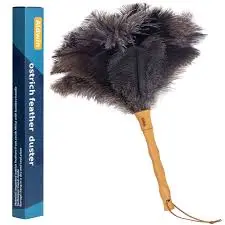
Widely regarded as the gold standard for natural dusters. Ostrich down feathers are uniquely branched with hundreds of tiny filaments per feather, creating a cloud-like surface area that traps dust at the microscopic level. The natural oils in ostrich feathers help them hold particles longer before needing to be shaken out. Black ostrich feathers (from male birds) are softer and trap more dust; grey feathers (from females) are slightly less effective but still excellent.
Pro Tip: If you’re buying a natural ostrich duster, look for black feathers — they come from male ostriches, are softer, and trap significantly more dust than the grey alternatives.
2. Microfiber Dusters
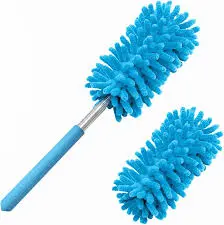
Microfiber is the most popular modern alternative. Made from ultra-fine polyester-nylon split fibers that are 100 times thinner than a human hair, microfiber generates a strong electrostatic charge that locks in dust and allergens. Unlike natural feather dusters, microfiber heads can be machine-washed, are hypoallergenic, and work both dry and slightly damp — making them incredibly versatile. They’re the top choice for allergy sufferers and households with pets.
3. Lambswool Dusters
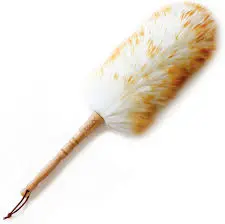
Lambswool is a premium natural option that shares ostrich feathers’ ability to generate static electricity and trap dust. It’s exceptionally soft, durable, and biodegradable. The downside: it requires careful maintenance with mineral oil to preserve the fibers, and it costs more than microfiber alternatives.
4. Cheap Synthetic / Chicken Feather Dusters
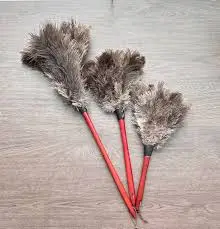
These are the plastic-handled dusters sold cheaply at grocery stores. Chicken feathers lack the fine filament structure that makes ostrich feathers effective, so they mostly push dust around rather than trapping it. They also shed feathers almost immediately. Avoid these entirely — they’re the reason most people have a negative impression of feather dusters.
5. Extendable Multi-Piece Duster Sets
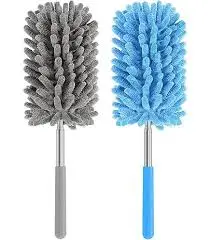
This is the most practical category for homeowners who want a complete cleaning solution. A quality extendable duster set includes multiple head types (flat, round, flexible) and a telescoping pole that extends anywhere from 30 to 100+ inches. This single system replaces the need for a step ladder AND multiple specialty dusters — making it the best value per dollar of any option on the market.
Feather Duster vs. Microfiber vs. Disposable: Full Comparison
| Factor | Feather (Ostrich) | Microfiber | Disposable |
| Dust Pickup | ⭐⭐⭐⭐⭐ Excellent | ⭐⭐⭐⭐⭐ Excellent | ⭐⭐⭐ Good |
| Delicate Surfaces | ✅ Best | ✅ Great | ❌ Risk of scratching |
| Electronics Safe | ✅ Yes | ✅ Yes | ❌ Static risk |
| Washable / Reusable | Shake & occasional wash | ✅ Machine washable | ❌ Single use |
| Hypoallergenic | ❌ Natural fibers | ✅ Yes | ✅ Mostly yes |
| Works Wet | ❌ No | ✅ Yes | Some versions |
| Extendable Options | ✅ Yes | ✅ Yes (best range) | ✅ Limited |
| Long-Term Cost | 💰 Low | 💰 Lowest | 💰💰💰 High (refills) |
| Eco-Friendly | ✅ Yes | ✅ Yes | ❌ Wasteful |
| Best For | Antiques, art, décor | Full-home, allergy sufferers | Quick spot-clean |
5 Things to Check Before Buying a Feather Duster
Most buyers make the mistake of choosing based on price alone. Here are the five real factors that separate a duster that works brilliantly from one that ends up in the bin after a week.
1. Handle Length & Extendability
This is arguably the most important spec. A fixed 12-inch handle is almost useless for ceiling fans, high shelves, or crown molding. Look for an extendable pole — ideally one that reaches at least 60 to 100 inches when fully extended.
A telescoping stainless steel pole locks securely at different lengths and is far more durable than plastic alternatives. If you ever need to clean a ceiling fan, the top of a wardrobe, or a high-mounted air conditioner unit without a ladder, this feature is non-negotiable.
2. Number & Variety of Heads Included
A single round duster head is fine for open shelves, but it won’t fit between window blind slats or clean inside a tight bookcase gap.
The best duster sets come with multiple head shapes — flat heads for blinds and vents, round fluffy heads for open surfaces, and flexible heads that can be angled for awkward spaces. A 7-piece set that covers all these use cases is dramatically more useful than buying three separate specialty dusters.
3. Material Quality
Natural ostrich down and high-grade split microfiber are the only two materials worth your money. Avoid cheap chicken-feather dusters — the coarse barbs push dust around rather than trapping it. When checking microfiber, rub it against your palm; good microfiber grabs your skin slightly. Poor-quality microfiber feels smooth and slips right off, meaning it won’t trap dust either.
4. Ease of Cleaning
Any duster you buy needs to be easy to shake out or wash — otherwise you’ll be dusting your surfaces with a pre-loaded cloud of old dust. Microfiber heads that detach from the pole for machine washing are the gold standard. Avoid any duster where the head is permanently glued to the handle with no way to clean it.
5. Build Quality & Pole Mechanism
Cheap extendable poles have a frustrating tendency to collapse mid-clean or spin in your hand. A good pole uses a secure twist-lock or button-lock mechanism and is made from aluminium or stainless steel rather than hollow plastic. The connection between head and pole should be firm — a wobbly head makes it nearly impossible to apply the light touch that effective dusting requires.
Common Feather Duster Mistakes to Avoid:
- Pressing too hard — feather dusters work with a light, sweeping touch. Pressing defeats the static charge
- Dusting from bottom to top — always start high and work downward
- Using a full duster head on electronics — use the corner of the head and move gently
- Never cleaning the duster itself — a dirty duster re-deposits dust. Shake it out after every use
- Using a wet duster on wood — natural feather and microfiber dusters work dry
Our Top Pick: 7-Piece Feather Duster Set with 30–100 Inch Extendable Pole
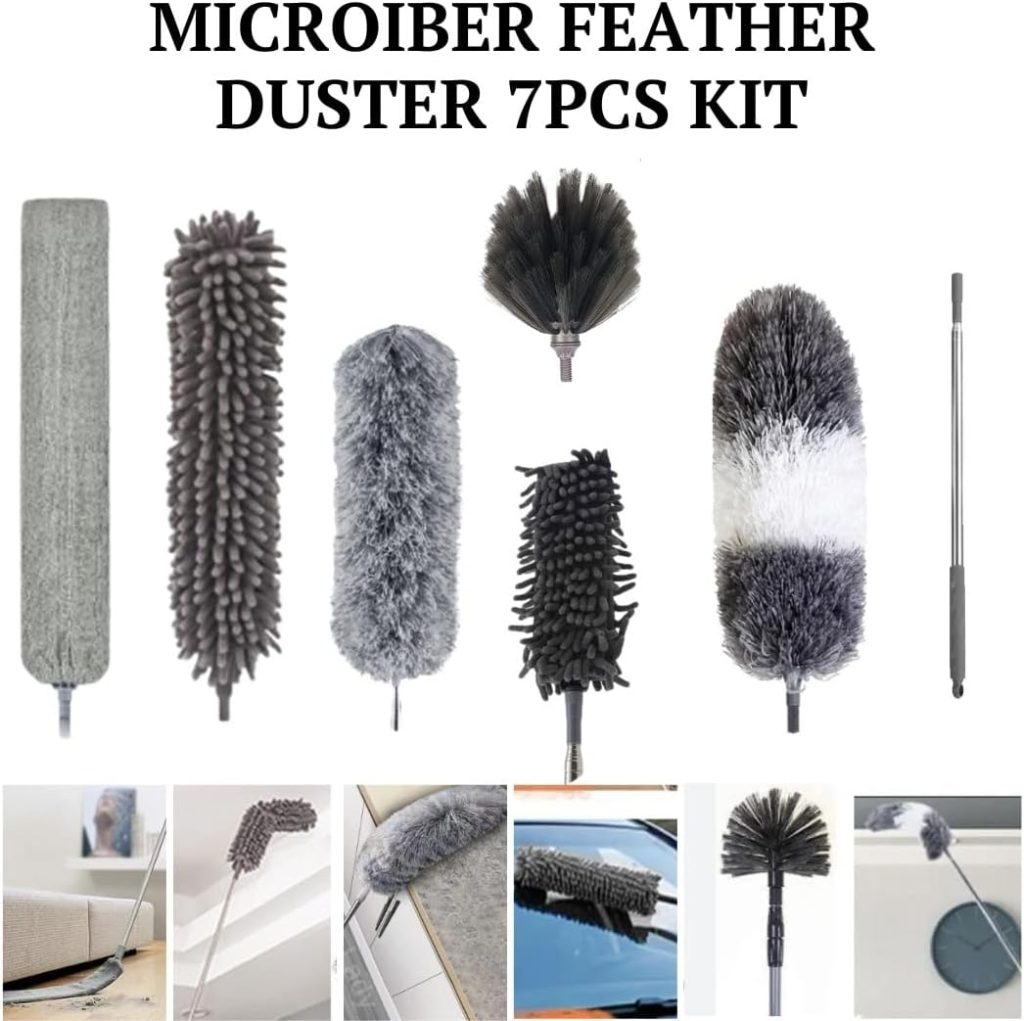
After reviewing everything the market has to offer, one set stands out for homeowners who want a single, comprehensive cleaning solution without paying a premium for multiple separate tools.
Why this set wins:
- 30–100 inch extendable pole — Reach ceiling fans, high shelves, and AC units without a ladder
- 7 different head attachments — Multiple shapes for every surface and space in your home
- Replaceable & washable heads — Swap heads for different jobs or when one needs washing
- Premium microfiber filaments — Electrostatically charged to trap dust instead of spreading it
- Full-home coverage — Blinds, fans, vents, bookshelves, furniture — one kit does it all
- Reusable & eco-friendly — Machine-washable heads save money vs. disposable refill systems
How to Use a Feather Duster Properly (Step-by-Step)
Most people use feather dusters incorrectly — and then blame the tool when the surface doesn’t look clean. The technique matters almost as much as the product.
Step 1: Always Start at the Top Begin with the highest surface in the room — ceiling fans, the tops of wardrobes, crown molding — and work your way down. Gravity will carry any loosened dust downward onto surfaces you haven’t cleaned yet, so you never want to dust a low shelf first.
Step 2: Use a Light, Sweeping Stroke The electrostatic charge in the fibers is doing the work — not pressure. A light, flowing swipe across the surface is all you need. Pressing down hard will flatten the filaments and reduce their surface area. Think of it as tickling the dust off, not wiping.
Step 3: Extend the Pole for High Reach Adjust the telescoping pole to the length that lets you clean comfortably with your arm at a relaxed angle. For ceiling work, fully extend the pole and use smooth, overlapping passes.
Step 4: Rotate the Head for Full Coverage Angle the duster head so it faces the surface fully, and rotate it slightly as you go to expose fresh, clean fibers. Most high-quality duster heads have a flexible joint — use it to your advantage on vertical surfaces like book spines and blinds.
Step 5: Shake Out Outdoors Every Few Minutes Step outside and give the duster a firm shake every few surfaces. This dislodges trapped dust particles and restores the fibers’ capacity. Never shake your duster indoors — you’ll just redistribute the dust you just collected.
Step 6: Finish with Floors Once you’ve dusted all surfaces from top to bottom, vacuum or mop. This sequence — dust first, vacuum last — is how professional cleaners work and why their results are consistently better.
Pro Tip: For electronics and TV screens, use a barely-touching hover technique and let the static charge do the lifting. You’ll remove dust without risking scratches from any grit caught in the fibers.
Room-by-Room Feather Duster Guide
Living Room Ceiling fan blades, TV screen bezels, bookshelves, picture frames, lampshades, skirting boards. Use a round head for open shelves and a flat head for fan blades.
Kitchen Top of fridge and cabinets, range hood exterior, exposed shelving. Extend the pole to full height for above-cabinet gaps that rarely get cleaned.
Bedroom Top of wardrobe, ceiling light fittings, bed headboard, window sills, blinds. A flat flexible head works perfectly for window blind slats.
Bathroom Light fixtures, the tops of door frames, exhaust vents, mirror frames. Bathroom corners near vents collect dust faster than you’d expect.
Home Office Monitor bezels, keyboard tops, under-desk cable trays, printer surfaces, shelving. Use the smallest, most precise attachment for electronics.
Hallways & Stairs Stair banisters, coving, overhead light fittings, skirting boards. A long pole means you never need a ladder for overhead areas.
How to Clean & Maintain Your Feather Duster
Microfiber Duster Heads
After each use, shake the head vigorously outdoors. For a deeper clean (every 4–6 uses, or when the head looks grey), detach the microfiber head and wash it by hand in warm water with a small amount of mild liquid soap. Rinse until the water runs clear. Do not use fabric softener — it coats the microfiber strands and destroys their electrostatic properties. Air dry completely before reattaching. Many quality heads are also machine-washable on a gentle cold cycle in a mesh laundry bag.
Natural Ostrich Feather Dusters
Shake vigorously outdoors after each use. For a deeper clean, swish the feather end gently in a basin of lukewarm water with a few drops of mild soap. Rinse under cool running water, gently squeeze (never wring) out excess water, then hang the duster upside down by the handle and allow it to fully air dry in a warm, ventilated area. Never use a hairdryer or direct heat. Once dry, give it one final shake and it will fluff back up to its original shape.
Storage Tip: Always hang your duster by the handle when storing — never lay it flat or rest the head on a shelf. Storing it compressed will permanently deform the fibers and reduce performance.
Dusting Tips for Allergy Sufferers
If you or someone in your household suffers from dust allergies, asthma, or hay fever, dusting incorrectly can make symptoms significantly worse.
Choose a microfiber duster over natural feathers. While high-quality ostrich feather dusters are excellent at trapping dust, the natural fibers themselves can carry pollen and trigger reactions in sensitive individuals. Microfiber is hypoallergenic and can be washed clean of all trapped particles.
Always wear a dust mask when doing a full room clean. Open windows before you start so fresh air carries displaced particles outward rather than recirculating them. After dusting, leave the room for 20–30 minutes before vacuuming with a HEPA-filter vacuum to capture any settling particles.
Frequency matters enormously for allergy management. Dusting every 4–5 days prevents thick dust layers from forming — heavy accumulation releases far more particles into the air when disturbed than thin, freshly-settled dust. With an extendable duster set, a full-home dust-down should take no more than 15–20 minutes.
Frequently Asked Questions
Conclusion
In conclusion, the 2026 feather duster guide highlights how this timeless tool has evolved into an eco-friendly, versatile essential for effortless cleaning.
Opt for quality options like ostrich down or microfiber with extendable poles and multi-head sets to tackle dust effectively on delicate surfaces, high reaches, and allergy-prone homes—saving time, money, and the environment while achieving professional results. Upgrade today for a smarter, dust-free life.