The best storage box for most people is a clear, stackable plastic storage box with a secure latching lid. It offers visibility, durability, and moisture resistance.
Fabric bins suit open shelving and closets. Heavy-duty plastic or weathertight models are best for garages and basements. The right choice depends on your space, contents, and how often you need access.
What Is a Storage Box?
A storage box is a reusable container designed to organize, protect, and store belongings in homes, offices, garages, warehouses, and during relocation.
Also called a storage bin, storage tote, or storage container depending on region and design, these products come in a wide range of materials — plastic, fabric, wood, metal, and cardboard — and serve needs from daily household clutter control to long-term seasonal archiving.
The global demand for storage solutions has grown steadily alongside smaller living spaces, minimalist lifestyle trends, and the rise of home organization culture.
Whether you are decluttering a bedroom closet, organizing a garage workshop, or protecting holiday decorations year-round, the right storage box makes retrieval faster, preserves your belongings, and improves how a space looks and functions.
Types of Storage Boxes
Understanding the main categories prevents costly buying mistakes. Each type has a clear strength and a clear limitation.
Plastic Storage Boxes

Plastic storage boxes are the most versatile and widely purchased type. Made from polypropylene or high-density polyethylene (HDPE), they resist moisture, tolerate heavy loads, and stack securely. Clear versions let you identify contents without opening the lid. Snap-on, hinged, or latching lids provide varying levels of dust and pest protection.
Plastic storage boxes range from lightweight 6-quart desktop organizers to 66-quart heavy-duty garage totes. Weathertight plastic models add a rubber gasket seal, making them suitable for basements, attics, and outdoor sheds where humidity and temperature fluctuate.
Best for: Garages, basements, attics, long-term storage, seasonal clothing, holiday decorations, moving
Fabric Storage Bins

Fabric storage bins use a canvas, linen, or polyester exterior over a rigid cardboard or wire frame insert. They are lightweight, collapsible when not in use, and visually compatible with living rooms, nurseries, and bedroom shelves. Most include rope or fabric handles for easy carrying.
The trade-off is protection. Fabric bins offer no moisture resistance, minimal pest deterrence, and lower structural rigidity compared to hard-sided plastic boxes. They are best suited for clean indoor environments and frequently accessed items like blankets, toys, and clothing.
Best for: Open shelving, closet cubbies, living rooms, nurseries, linen storage
Collapsible Storage Boxes

Collapsible storage boxes combine a rigid structure when in use with flat, fold-down sides when empty. This design saves significant storage space between uses — some models reduce to as little as 20 percent of their open volume. Most are made from reinforced fabric or flexible plastic.
They work well for households with limited storage room or for seasonal use cases where the box itself needs to be stored away between purposes.
Best for: Seasonal items, small apartments, travel, occasional storage needs
Weathertight and Airtight Storage Containers
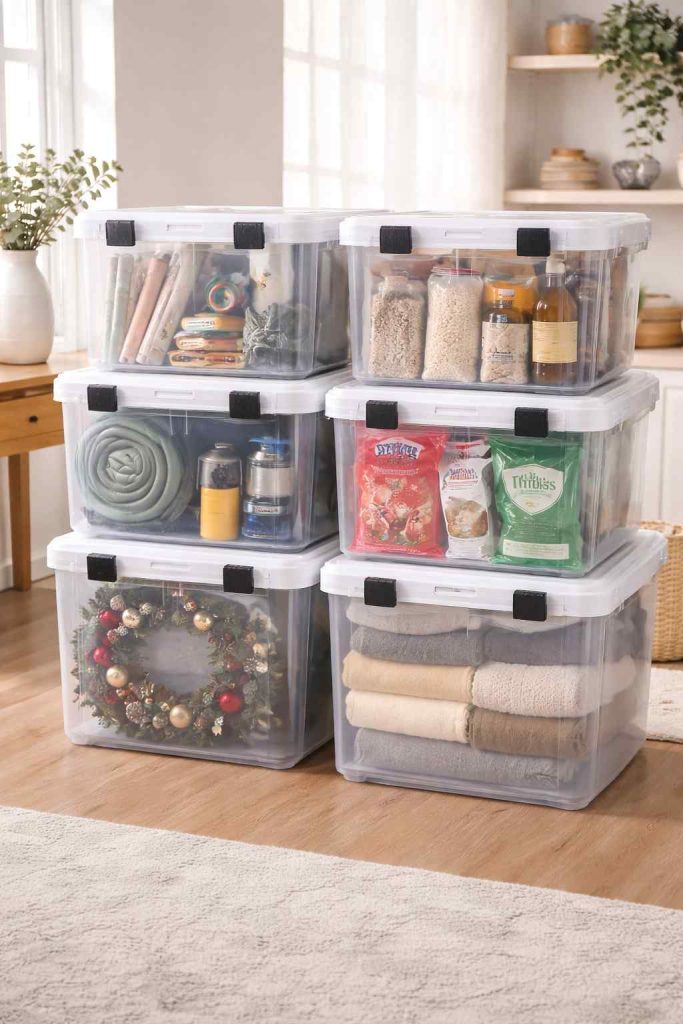
Weathertight boxes include a rubber or foam gasket around the lid perimeter that creates a near-airtight seal when latched. This prevents moisture, dust, insects, and mold from reaching stored contents. They are significantly more protective than standard plastic totes.
Airtight storage containers take this further, designed to maintain consistent internal humidity — important for archival documents, photographs, textiles, and electronics.
Best for: Basements, garages, outdoor sheds, attics, sensitive documents, heirlooms, photographs
Under-Bed Storage Boxes

Under-bed storage boxes feature a low-profile, flat design with a large horizontal footprint. Most include wheels for smooth retrieval and a lid to control dust. A standard queen-size bed accommodates two of these boxes end to end, effectively doubling usable closet space.
Key measurements to check: clearance height under your bed frame (typically 6 to 9 inches) and internal dimensions to confirm the box holds what you intend to store.
Best for: Seasonal clothing, extra bedding, shoes, infrequently used items
Wooden Storage Boxes and Crates

Wooden storage boxes and crates serve both functional and decorative purposes. Solid wood or MDF construction gives them significant visual weight and durability. They work as side tables, window seat storage, or decorative pieces that blend into a room’s decor.
The main limitations are weight, cost, and sensitivity to moisture. Wood requires more maintenance than plastic and is not appropriate for damp environments without proper sealing.
Best for: Living rooms, entryways, children’s toy storage, decorative organization
Cardboard Storage Boxes

Cardboard boxes are inexpensive, widely available, and recyclable. They are an appropriate choice for short-term storage, moving, and single-use shipping. For long-term household storage, however, cardboard is the least effective option. It absorbs moisture, attracts pests, compresses under weight, and degrades over time.
If cardboard is the only available option, store the boxes inside a climate-controlled, dry space and replace them with plastic or fabric alternatives as soon as possible.
Best for: Moving, short-term storage, shipping, temporary use only
Storage Box Materials Compared
| Material | Moisture Resistance | Pest Resistance | Stackability | Durability | Cost |
| Plastic (standard) | Good | Good | Excellent | High | $10–$40 |
| Plastic (weathertight) | Excellent | Excellent | Excellent | Very High | $20–$70 |
| Fabric | Poor | Poor | Low | Medium | $8–$25 |
| Wood | Low–Medium | Medium | Low | High | $20–$100+ |
| Cardboard | Very Poor | Very Poor | Low | Low | $1–$5 |
| Metal | Excellent | Excellent | Medium | Very High | $30–$120 |
Key Buying Factors for Storage Boxes
1. Size and Internal Dimensions
Always measure both the space available and the items you plan to store before purchasing. Box listings typically show external measurements, which are always larger than usable internal volume due to wall thickness. A 30-gallon box may have an internal height that accommodates folded sweaters but not hanging garments.
Common size ranges by use case:
- Small (6–15 quarts): Desktop organization, bathroom items, craft supplies, pantry storage
- Medium (18–30 quarts): Clothing, shoes, books, kitchen goods
- Large (40–60 quarts): Bedding, holiday decorations, sporting equipment
- Extra-large (66+ quarts): Garage gear, bulk items, moving
2. Lid Type and Seal Quality
The lid is one of the most important parts of any storage box. Loose lids allow dust accumulation and topple during stacking. Evaluate these options:
- Snap-on lids: Simple and cost-effective, suitable for indoor use
- Latching lids: Provide more security; ideal for stacking and transport
- Gasket-sealed lids: Offer weathertight or airtight protection; essential for damp environments
- Hinged lids: Allow easy opening without removing the lid entirely; convenient for frequently accessed items
3. Stackability and Structural Integrity
A storage box that cannot support weight on top wastes vertical space. Look for lids with reinforced ribbing, interlocking edges, or recessed bases that lock onto the lid below.
Polypropylene walls thinner than 1.5 mm may buckle under loads above 40 pounds. Heavy-duty reinforced models support 60 percent more stacking weight.Check manufacturer stacking ratings, and always place heavier boxes on the bottom of a stack to prevent collapse.
4. Transparency and Visibility
Clear or semi-transparent storage boxes significantly reduce retrieval time. You can identify contents at a glance without opening multiple boxes. This is particularly valuable in garage, basement, and closet settings where many boxes are stored side by side.
If you prefer opaque boxes for aesthetic reasons, use a label maker or adhesive label pockets on the exterior to maintain quick identification.
5. Handles and Portability
Integrated handles — whether molded grips, cut-out openings, or fabric loops — are essential for boxes used in garages, basements, or any context where the box will be moved frequently. Evaluate handle ergonomics when the box is fully loaded. Some heavy-duty models include wheels, which are valuable for large under-bed totes or garage storage systems.
6. Material Safety
For storage boxes used in children’s rooms, pantries, or kitchens, confirm that materials are BPA-free and non-toxic. Food-safe certification is required if the box will contact food directly. Standard polypropylene totes are safe for general household use but are not food-grade containers.
7. Weight Capacity
Each box has a maximum rated load. Exceeding this limit risks cracking, lid failure, or collapse — especially in stacked configurations.
Reinforced plastic bins handle heavier loads; fabric bins are best limited to lightweight items like clothing and linens.
Also Read here : Best feather duster
How to Choose the Right Storage Box for Your Space
Closets and Bedrooms

Prioritize stackable clear plastic boxes in small-to-medium sizes or fabric bins that match your closet system. Under-bed storage boxes work well for seasonal clothing and spare bedding. Keep frequently used items accessible and rotate seasonal items to harder-to-reach locations.
Garages and Workshops

Durability and moisture resistance are the priority. Use heavy-duty plastic storage boxes with latching lids in large sizes. Weathertight boxes protect power tools, seasonal gear, and hardware from humidity. Color-coded or labeled boxes by category — automotive, gardening, sports — reduce search time significantly.
Basements and Attics

Temperature and humidity fluctuate in both spaces. Weathertight or airtight boxes are the correct choice for basement and attic storage. Avoid cardboard or fabric bins entirely. Use raised shelving units to keep boxes off the floor in case of minor flooding.
Home Offices

Small to medium plastic or decorative storage boxes work for file organization, craft supplies, and stationery. Modular systems with consistent dimensions allow efficient use of shelf and desk space. Labeled, lidded boxes reduce visual clutter without sacrificing accessibility.
Children’s Rooms and Playrooms

Soft-sided fabric bins reduce injury risk in children’s spaces. Open-top bins without lids make it easier for children to self-organize and clean up. Durable plastic bins in bright colors are suitable for toy storage in rooms where rough handling is expected.
Storage Box Sizing Guide
| Contents | Recommended Size | Approximate Capacity |
| Shoes (1 pair) | Small | 6–10 quarts |
| Folded sweaters (4–6) | Medium | 18–22 quarts |
| Full bedding set | Large | 40–50 quarts |
| Holiday decorations | Extra-large | 60–66 quarts |
| Garage tools | Heavy-duty large | 40–60 quarts |
| Books (one shelf) | Medium-large | 30 quarts |
| Craft supplies | Small–Medium | 12–20 quarts |
Storage Box Features Worth Paying More For
Not every premium feature justifies the price increase, but several upgrades provide clear, measurable benefits.
Rubber gasket seals are worth the extra cost for any box stored in a basement, garage, or attic. The gasket prevents moisture intrusion that damages textiles, paper, and electronics over months and years.
Reinforced lids matter if you plan to stack multiple boxes. A lid rated to support stacking weight prevents collapse in multi-tier storage setups.
Integrated label windows or writable panels on the exterior save time on every retrieval. This is a small feature with consistent daily value in high-volume storage environments.
Wheels and pull handles on large storage boxes reduce physical strain. If you are storing 40-to-66-quart totes under a bed or at floor level, wheels pay for themselves quickly.
Storage Box Maintenance and Care
A quality storage box lasts years with minimal upkeep. Follow these practices to extend lifespan and protect stored contents.
Clean before storing. Residual moisture, food particles, or debris inside a box promotes mold growth, especially in humid conditions. Wipe the interior dry before sealing.
Inspect lids and latches periodically. Latches can become brittle over time, particularly in temperature-extreme environments. Replace damaged lids or latches before relying on a seal for long-term storage.
Avoid overpacking. Overpacking stresses box walls, distorts the lid seal, and increases damage risk when moving the container. Leave 10 to 15 percent of interior volume free for cushioning and safe lid closure.
Store heavy boxes low. Place heavier containers on the bottom shelf or floor level. Stacking heavy boxes above eye level is a safety risk and increases the chance of structural failure.
Use desiccant packs in sealed boxes. Silica gel packets absorb residual moisture trapped inside sealed boxes, protecting fabric, paper, and electronics from humidity damage over extended storage periods.
Frequently Asked Questions
Storage Box Buying Checklist
Before purchasing, confirm each of the following:
- Measured internal dimensions (not just external) against the space available
- Lid type matches the protection level required (snap, latch, or gasket)
- Material is appropriate for the storage environment (plastic for damp, fabric for dry indoor use)
- Box supports the expected load weight, especially if stacking
- Handles are present and ergonomic if the box will be moved regularly
- Transparency or label space allows quick content identification
- Size fits neatly within the intended shelving, closet, or under-bed clearance
- Material is BPA-free if used in children’s rooms or near food
Final Word on Choosing the Right Storage Box
A storage box may seem simple, but choosing the right one prevents clutter, protects belongings, and makes organization easier. The best option depends on where you store items, what you store, and how often you access them.
For most homes, clear stackable plastic boxes in a few standard sizes work for everyday storage. Add weathertight boxes for garages or basements, fabric bins for visible shelves, and under-bed containers for seasonal items. Using consistent box sizes in each space also makes stacking, labeling, and finding items much more efficient.